

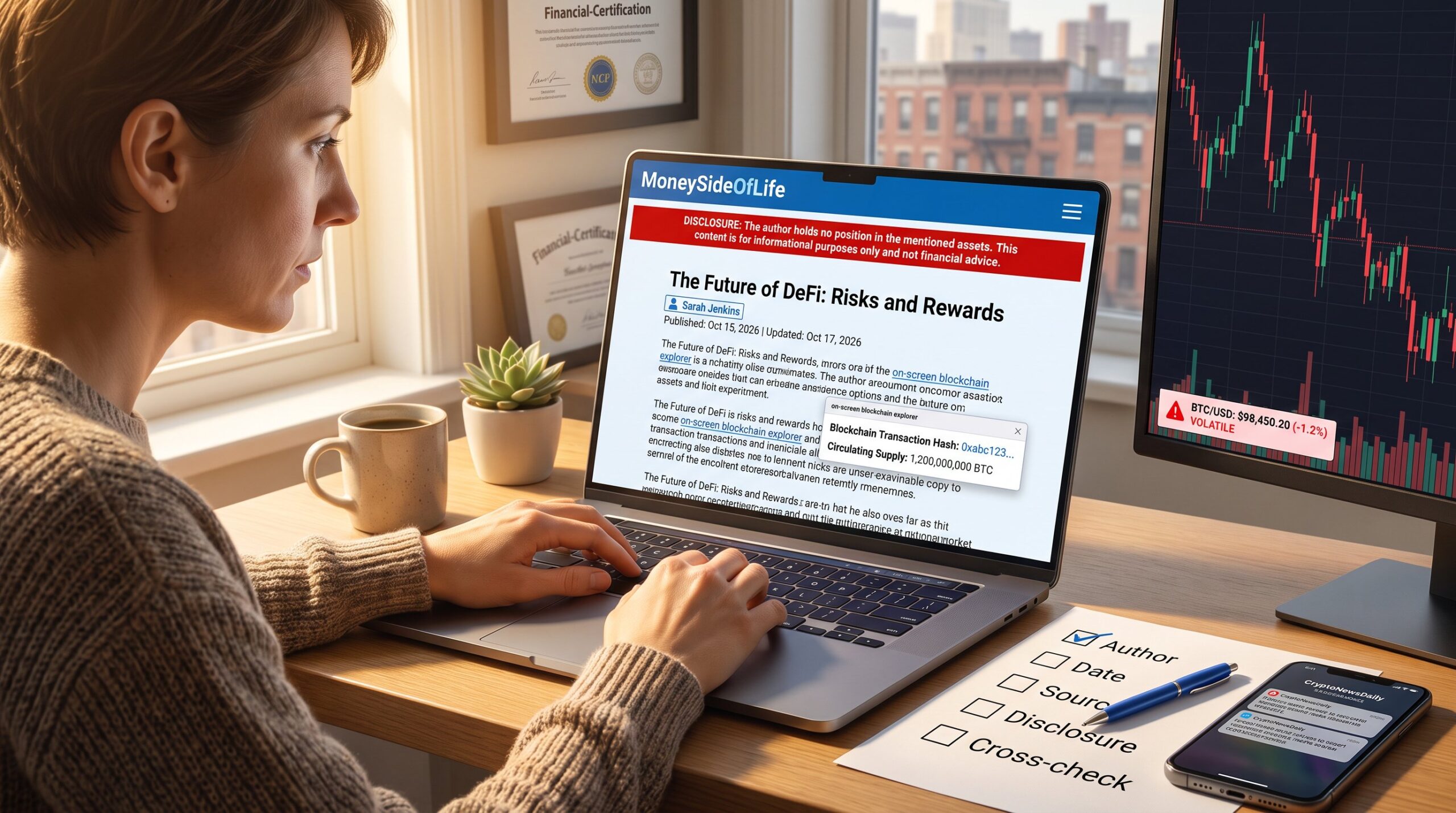
How to evaluate crypto coverage on MoneySideOfLife matters because small errors or hidden incentives in an article can cost real money. Readers who rely on website analysis must check authors, dates, data sources, and disclosures before acting. This guide gives a practical, checklist-style approach readers can apply in minutes. It explains what to look for, why each item matters in 2026’s fast-moving markets, and how to verify claims with on-chain or market data. The steps assume no prior expertise and focus on clear signals that separate useful reporting from risky promotion.
Key Takeaways
- Evaluating crypto coverage on MoneySideOfLife helps prevent costly mistakes in volatile markets by encouraging readers to verify authors, dates, and disclosures before acting.
- Always confirm article transparency by checking author credentials, publication dates, cited sources, and explicit disclosures to distinguish quality reporting from promotional content.
- Use a quick, comprehensive checklist to assess tone, evidence, and multiple source confirmations, which safeguards against hype-driven investments and misinformation.
- Cross-verifying key claims with on-chain data or reputable market aggregators ensures accuracy and reduces reliance on outdated or biased information.
- Treat MoneySideOfLife articles as educational resources, not direct investment advice, and invest time (5–12 minutes) in due diligence to enhance decision-making in 2026’s fast-moving crypto landscape.
Why Evaluating Crypto Coverage Matters Before You Act
Fact first: poor crypto coverage can produce real financial loss. In volatile markets, a single promotional article or an outdated explainer can lead someone to buy at a peak or ignore critical protocol risks. For example, buying into a token after a bullish blog that omits reserve dilution or smart-contract bugs has cost everyday investors thousands.
Why it matters now: 2026 saw several rapid protocol unwindings and exchange liquidity shocks. Those events showed how quickly market realities can outpace static articles. MoneySideOfLife publishes many practical guides and reviews: readers must treat each piece as education, not investment advice. That mindset reduces impulse reactions when headlines shout “to the moon.”
Immediate takeaway: always check transparency signals before acting on any crypto piece. Look for named authors, clear dates, and explicit disclosures. These small checks catch most missteps early, for example, spotting a six-month-old article with unchanged price projections or a sponsored review without a holdings statement.
Practical warning: assume an article is promotional until it proves otherwise. That default saves time and prevents regrets. A disciplined reader who pauses, verifies, and cross-checks will avoid many common traps such as hype-driven buys, pump-and-dump schemes, or mistaken protocol assumptions.
Key Criteria To Judge Quality, Accuracy, And Bias
Fact first: six criteria reliably expose quality, accuracy, and bias in crypto coverage. They are: source & author, date & timeliness, evidence & data, tone & language, disclosures, and cross-verification.
Source & author: quality articles name the author and link to a bio or team page. A verifiable background in finance, crypto engineering, or journalism matters. MoneySideOfLife readers should confirm the author’s other work or LinkedIn profile. If an author lacks public credentials, treat claims cautiously.
Date & timeliness: crypto changes fast. An article with an older date may still be useful for concepts but not for price, supply, or governance details. Check for visible publication and update dates: if missing, consider the piece stale.
Evidence & data: strong coverage cites primary sources, project blogs, audited smart contract reports, blockchain explorers, and market feeds. Working links and screenshots that trace numbers to on-chain evidence are good signs. Where a claim depends on a whitepaper or audit, the article should link to those documents.
Tone & language: balanced pieces highlight upside and concrete risks. Red flags include guaranteed-return language, repeated hype words, and pressure tactics. Neutral wording with quantified uncertainties is preferable.
Disclosures: look for sponsorship labels, affiliate notes, and holdings disclosure. Honest outlets include corrections and an updates policy. Absence of any disclosure often signals a promotional angle.
Cross-verification: every major factual claim should match at least two independent sources or on-chain data. For protocol metrics, compare site claims with an explorer or market aggregator to confirm supply, treasury, or lockup numbers.
Evidence note: general evaluation techniques are supported by industry guidance on analyzing crypto projects, such as the frameworks laid out by analyst resources that recommend reading white papers and team histories to spot problems (Investopedia guidance).
Step-By-Step: How To Apply These Criteria To MoneySideOfLife Articles
Fact first: apply a short checklist to any MoneySideOfLife crypto article in under five minutes.
-
Confirm author transparency. Open the article and click the author name. Does MoneySideOfLife list a team page with credentials? If yes, scan for finance or tech experience. If the author lacks a profile, flag the piece for deeper source checks. Use the site’s team and about pages to confirm credibility.
-
Verify the date and recent updates. If the article is older than three months, run a quick search for developments that could change core facts. For token mechanics and treasury data, a three-month lag often matters.
-
Inspect cited sources. Follow links to official project posts, audits, or explorers. If the article claims a circulating supply or treasury size, confirm the numbers on-chain or via reputable aggregators. MoneySideOfLife often links to practical explainers: cross-reference those with primary sources.
-
Assess tone and red flags. Scan for phrases like “guaranteed returns” or heavy promotional language. If the article is review-like, look for a disclosure statement about sponsorships or affiliate revenue.
-
Look for explicit disclosures. Sponsors, review samples, or the author’s asset holdings should be declared. If a review praises a token without a disclosure, treat the recommendation as suspect.
-
Cross-check core claims. Confirm at least two independent sources for any financial claim, another outlet, a blockchain explorer, or a project repo. MoneySideOfLife’s cluster includes practical primers and product explainers: readers should anchor technical claims to those foundational pages such as the site’s wallet explainer or the primer on how to research tokens.
-
Use the pillar guide for context. Before forming an opinion, consult the site’s broad overview to align vocabulary and risk definitions with the article’s framing by following a short connected piece about digital-asset risks in the MoneySideOfLife pillar crypto guide.
-
Drill into specialized topics. If the article discusses reserves, loans, or tokenomics, verify against related MoneySideOfLife deep dives like the post on crypto reserves or the explainer on crypto loans.
-
Beware of timing and headlines. When prices spike, MoneySideOfLife runs “crypto to the moon” features. Those pieces mix tactical moves with high-risk ideas: match any tactical claim against a sober playbook such as the site’s 2026 playbook.
Real example: a reader noticed a MoneySideOfLife token review that claimed a frozen treasury. Following the article’s chain links to a GitHub audit revealed the treasury was in fact unfrozen. That single cross-check prevented a costly buy. The checklist above would have flagged the missing audit link in step 3.
Practical timing: the whole audit, author, date, sources, disclosure, and two independent confirmations, typically takes 5–12 minutes per article. That small investment avoids impulse mistakes in fast markets.
Conclusion
Actionable insight: use transparency checks, source verification, tone analysis, and cross-checking every time MoneySideOfLife covers crypto. Treat site articles as learning tools, verify key numbers on-chain or with market data, and never base a trade on a single article. A five- to twelve-minute checklist habit protects capital and improves decision quality in 2026’s volatile market.