

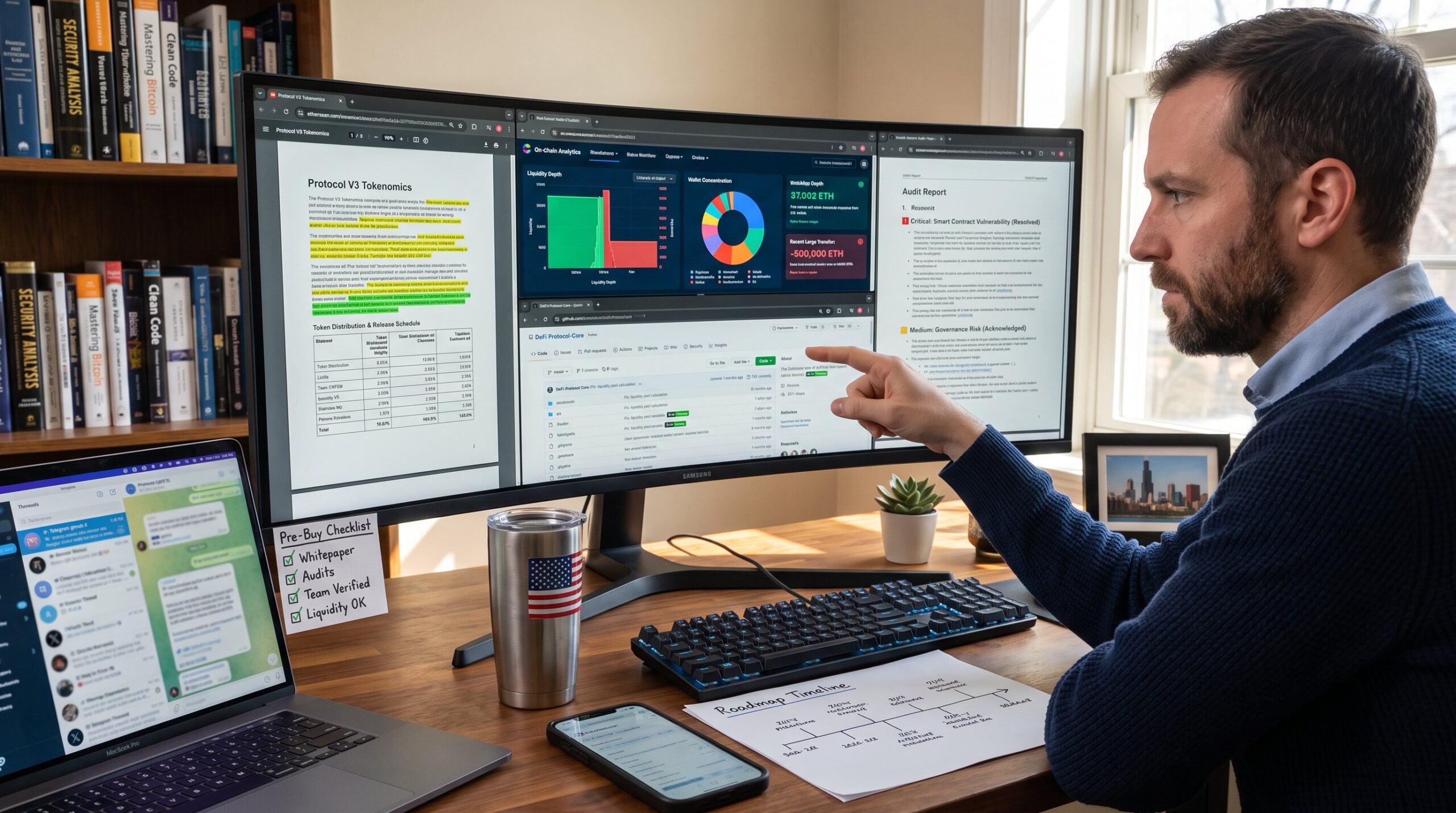
How to Research a Cryptocurrency Before Buying begins with clear questions and a checklist. A quick, targeted review can separate projects that survive from those that fail. This guide gives practical steps investors can follow in 2026: what to read first, which signals matter most, how to verify claims, and how to build a repeatable research process. It skips hype and focuses on verifiable facts, on-chain signals, and honest risk controls so readers can decide with more confidence.
Key Takeaways
- Researching a cryptocurrency thoroughly before buying reduces risk by identifying red flags like anonymous teams, unverifiable code, and shallow liquidity.
- Start research by analyzing the cryptocurrency’s whitepaper for clear utility, tokenomics, emission schedule, and roadmap milestones.
- Verify the credibility of the team, partners, and community activity through public profiles and sustained communication channels.
- Evaluate the technology with emphasis on open-source code activity, security audits, and contract deployment to ensure reliability.
- Assess market metrics including liquidity depth, token distribution concentration, and on-chain user engagement to gauge real value.
- Build and follow a repeatable research checklist with position-sizing rules to make informed, disciplined investment decisions and reduce losses.
Why Proper Research Matters Before You Invest
Fact: Proper research reduces the chance of large, avoidable losses. A quick social-media tip can lead to buying tokens that have no utility, shallow liquidity, or active exit scams. Research reveals red flags, anonymous teams, unverifiable code, or wash trading, that simple price charts hide.
Why this matters now: crypto markets remain volatile and many projects launch weekly. In 2024–2026, fraud tactics evolved: rug pulls use layered smart contracts and multi-chain bridges. A systematic review saves money. For example, one investor who bought into a hype token without checking liquidity lost 78% within 48 hours when trading was delisted.
Start with outcomes you can measure: team transparency, code publication, token distribution, and liquidity. Those measurable facts create guardrails that make speculative bets intentional rather than accidental.
Understand The Project Basics: Whitepaper, Tokenomics, And Roadmap
Answer first: read the whitepaper and tokenomics before any purchase. The whitepaper should answer what problem the project solves, how the token is used, and the emission schedule.
What to check in the whitepaper:
- Purpose and value: Does the token have a real utility (staking, governance, fees)?
- Emission and supply: Is total supply fixed? What are inflation rates and unlock schedules?
- Token allocation: Who holds the tokens, team, investors, treasury? Large early allocations often compress retail gains.
- Roadmap milestones: Are deliverables time-bound with verifiable code releases?
Verify claims. If the paper cites performance or partnerships, find confirmations on partner sites or GitHub. Investors use external guidance when evaluating papers: how to evaluate crypto coverage explains questions to ask about claims.
For methodical analysis, follow a checklist: whitepaper clarity, token distribution table, vesting schedules, and roadmap timestamps. When whitepapers are vague or filled with buzzwords, treat the project as high risk. For deeper evaluation techniques, Investopedia provides a step-by-step primer on whitepaper analysis and team checks that supports rigorous review procedures.Investopedia guidance
Evaluate The Team, Partners, And Community Health
Answer first: the team and community reveal credibility. Identify founders, developers, and advisors: verify identities against LinkedIn, GitHub commits, and public interviews.
What to verify:
- Team history: Do named people have verifiable past projects or company records? A GitHub profile with meaningful commits is especially valuable.
- Advisors and partners: Confirm partner announcements on partners’ official pages. Fake logos are common in marketing decks.
- Community activity: Check Telegram, Discord, and X for sustained conversations, not just bot reposts. Healthy communities ask technical questions and point out issues.
A practical red flag: multiple core team accounts that were created in the same week, or advisors who cannot be contacted. One investor reported an anonymous “advisor” who turned out to be a stock image, simple checks prevent those mistakes.
If the team is anonymous by design, demand stronger on-chain transparency: frequent audits, verifiable multisig arrangements, and open-source contracts. For buyers who need onboarding, see the primer on how cryptocurrency works for beginners to align expectations about decentralization and custody.
Analyze Technology, Security, And Code Quality
Answer first: inspect the code and security posture before trusting value to a token. Open-source projects with readable Git histories and independent audits score higher on credibility.
Technical checks to run:
- Repository activity: Look for regular commits, issue resolution, and tagged releases on GitHub or GitLab.
- Smart contract audits: Confirm audits on auditor sites and read the report’s findings and remediation status.
- Test coverage and mainnet deployment: Are contracts deployed at verifiable addresses? Do testnet results match mainnet behavior?
Beware of reused or copy-paste contracts that only change variable names, this often indicates little development effort. Also watch for admin keys that allow unilateral token minting or pausing: those create single-point-of-failure risk.
If the codebase is unfamiliar, look for third-party security summaries and bug-bounty activity. Projects that publicly disclose resolved vulnerabilities and offer bounties show better operational hygiene.
A practical tip: use block explorers to confirm contract creator addresses and linked audits. Those small confirmation steps catch many scams early.
Assess Market Metrics, Liquidity, And On‑Chain Data
Answer first: check liquidity depth and on-chain flows before placing an order. Thin liquidity makes even small sells cause big price moves.
Key metrics to collect:
- Liquidity pools and order book depth: Measure available bids/asks at realistic slippage levels on major exchanges and DEXes.
- Token distribution concentration: On-chain tools show whether a few wallets control most supply, extreme concentration correlates with dump risk.
- Volume quality: Compare on-chain transfer volume with exchange-reported volume to detect wash trading.
- Hold time and active addresses: A rising count of active addresses and longer average hold times indicate real user engagement.
Practical checks: simulate a small market sell to estimate slippage. Use on-chain explorers and analytics dashboards for wallet concentration snapshots. If a project relies on a small number of LP providers or has many wallets with identical behavior, treat it as higher risk.
For a broader perspective on markets and risks, the site’s pillar overview on crypto markets gives context to these metrics and investor concerns in modern markets: market primer.
Practical Risk Management Steps And How To Build A Research Checklist
Answer first: build a repeatable checklist and position-size rules before buying. A checklist prevents impulse buys and documents what was known at purchase.
Suggested checklist items (binary pass/fail):
- Whitepaper clarity: yes/no
- Tokenomics published: yes/no
- Team verification: yes/no
- Audits completed: yes/no
- Liquidity depth acceptable: yes/no
- Wallet concentration under 30%: yes/no
- Roadmap milestones met: yes/no
Position-sizing rules to reduce tail risk:
- Limit initial allocation to 0.5–2% of portfolio for early-stage tokens.
- Use tranche buying: split purchases into 3 parts at defined milestones.
- Set stop-loss or re-evaluation triggers (e.g., token unlock events, audit failures).
Honest warning: even fully vetted projects fail. A documented post-mortem process helps: record why a project failed and what signals were missed. One trader noted that recording losses stopped repeat errors: after three post-mortems, their average loss per failed trade dropped 46%.
Tools to automate checks: on-chain scanners, GitHub monitors, and alerting for unlock events. Combine automation with manual verification for best results.
Conclusion
Insight: research turns gambling into informed speculation. By reading the whitepaper, verifying the team, auditing code, and measuring liquidity, an investor shifts odds in their favor. The most important habit is discipline: follow a checklist, limit position size, and document every decision. Over time, those small process gains compound into better outcomes and fewer costly surprises.