

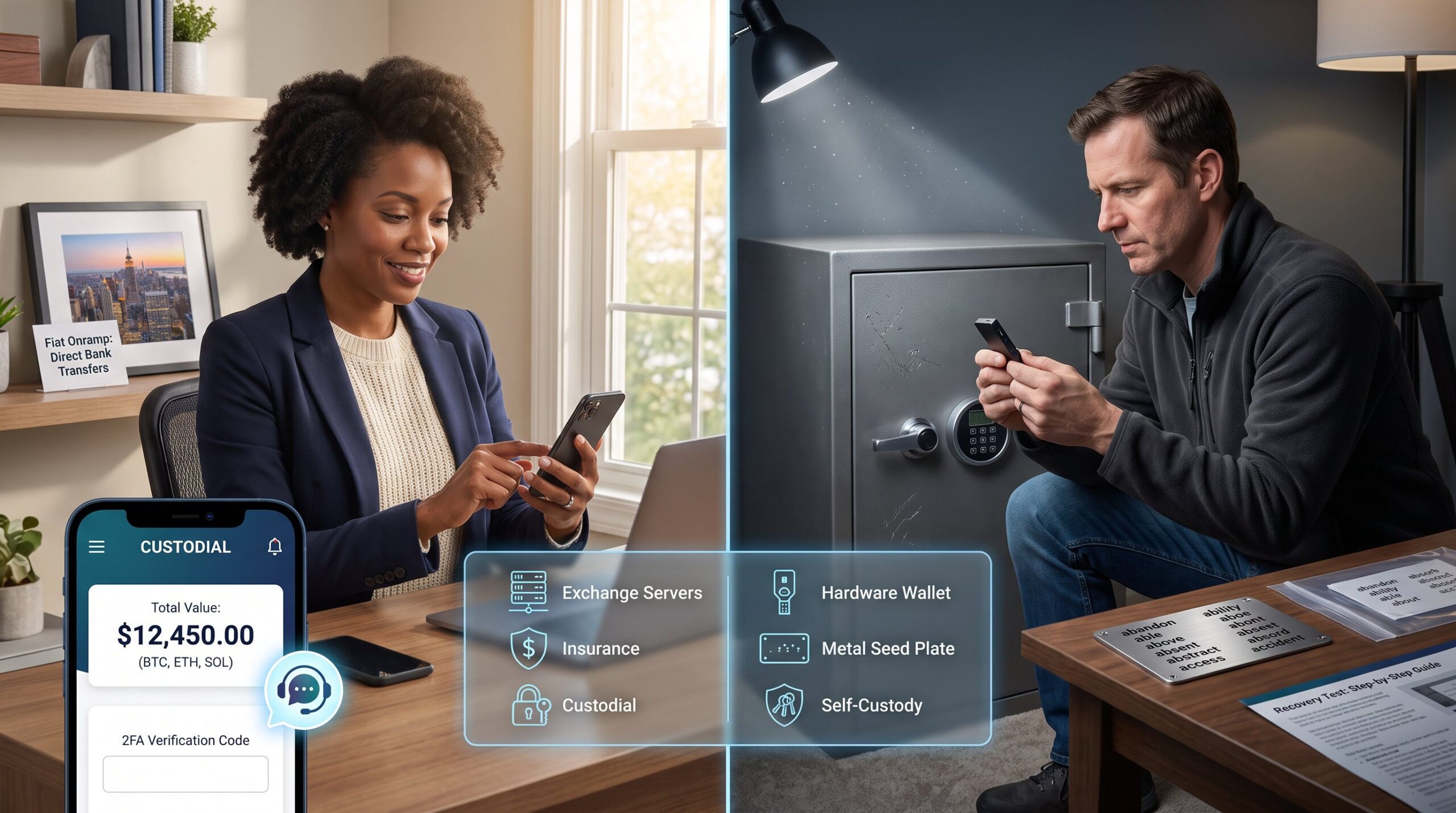
Crypto Wallets Explained: Custodial vs. Self-Custody opens the door to a practical decision every investor faces in 2026: who holds the keys to digital money? This article gives a concise, actionable map. It starts with core wallet concepts, then compares custodial services and self‑custody tools, and ends with clear criteria to choose a path. Readers who want to move from curiosity to control will find specific trade‑offs, real security practices, and links to deeper resources for research.
Key Takeaways
- A crypto wallet stores private keys that control access to blockchain assets, making key custody critical for security.
- Custodial wallets offer convenience and recovery options by entrusting private keys to third parties, suitable for small to medium balances and active trading.
- Self-custody wallets provide sole control through hot (software) or cold (hardware) wallets, requiring strong security practices and discipline.
- Cold wallets reduce online risks but introduce physical risks; using hardware wallets with encrypted backups and multi-signature setups enhances security.
- Choosing between custodial and self-custody depends on balancing convenience, trust, and responsibility for key management.
- A blended approach—using custodial wallets for daily spending and self-custody for long-term reserves—can optimize security and usability.
What Is A Crypto Wallet? Core Concepts You Need To Know
A crypto wallet stores the cryptographic keys that give someone control over blockchain assets. That is the simple fact: possession of private keys equals access to funds. Wallets do not hold coins the way a bank holds dollars: they keep credentials that sign transactions on a ledger.
How it works in plain steps: a private key signs a transaction, the signature moves an asset on the blockchain, and anyone with the corresponding public key can verify it. This separation explains why losing a key can mean permanent loss and why custody matters.
Concrete example: Alice’s wallet contains a private key that lets her move 0.75 ETH. If she loses that key without a backup, those 0.75 ETH become inaccessible. That precise, irreversible outcome is why backup strategies exist.
Key terms to remember: private key (secret signing string), public key (shareable address), seed phrase (human‑readable backup), hot wallet (connected to internet), cold wallet (air‑gapped). Knowing these terms lets a reader quickly evaluate options.
Common beginner mistakes: storing a seed phrase as a screenshot, copying it into cloud notes, or trusting a single device without backups. These errors create predictable loss scenarios. A practical next step: compare custodial and self‑custody approaches to see who shoulders that risk and responsibility.
Custodial Wallets: How They Work, Benefits, And Risks
Custodial wallets place private keys under a third party’s control. That is the core trade: convenience and delegated responsibility in exchange for trust. In practice, exchanges and wallet services like centralized platforms manage signing, custody, and account recovery tools for users.
Why people choose custody: it removes routine friction. A custodial service handles account recovery, integrates fiat onramps, and offers customer support. For example, a user can reset access through identity checks rather than reconstructing a seed phrase. Businesses often prefer custodial models because they simplify payroll, invoicing, and compliance.
Measured risks: custodial accounts concentrate threat. If a provider suffers a hack, mismanagement, or regulatory seizure, users may lose partial or full access. Historical data includes multi‑million dollar breaches and exchange insolvencies that froze client funds. That single failure point matters for anyone holding significant balances.
Security controls custodial providers use include cold storage allocations, insurance policies, multi‑party computation (MPC), and hardware security modules (HSMs). Independent guidance on selecting a qualified custodian is available through industry resources that outline custody standards and due diligence steps: a helpful reference discusses how to evaluate custodians’ practices and legal safeguards. custody selection guidance
Practical rule of thumb: use custodial services for small to medium balances, active trading, or when a recovery mechanism is essential. For larger, long‑term holdings, weigh the cost of entrusting a custodian against the security benefits they offer.
Self‑Custody Wallets: Types, Security Practices, And Trade‑Offs
Self‑custody hands private keys to the individual. That is the defining advantage: sole control. Self‑custody comes in two practical types: software (hot) wallets and hardware (cold) wallets. Each type has clear security practices and trade‑offs.
Hot wallets run on phones or browsers and prioritize convenience. Examples include MetaMask and mobile wallet apps. They make frequent transactions simple but increase exposure to malware, phishing, and device compromise. A concrete incident: a user who installed a malicious browser extension lost 2.3 ETH after approving a deceptive transaction. That scenario shows how easy mistakes convert to real losses.
Cold wallets use hardware devices or paper/metal backups and keep keys offline. Hardware devices like Ledger or Trezor sign transactions in an air‑gapped environment. For long‑term storage, many people pair a hardware wallet with a metal seed backup to resist fire and water. Cold storage reduces online attack surfaces, but it introduces physical risks: theft, damage, or misplacement.
Security practices that materially reduce risk:
- Use a hardware wallet for holdings over a defined threshold (e.g., >$5,000).
- Create multiple encrypted backups and store them in geographically separated locations.
- Test recovery by restoring the wallet on a spare device before you transfer large sums.
- Use multi‑signature setups if multiple parties should approve large transfers.
Trade‑offs to accept: self‑custody demands competency and discipline. People report losing funds during password resets or by reusing weak passphrases. A candid example: one investor overwrote a seed phrase file with a software update and could not recover $12,400. Those honest failures reveal that self‑custody requires process, not just a device.
For readers ready to research individual coins and wallet compatibility, MoneySideOfLife offers a grounded primer that helps evaluate projects, risks, and wallets in a stepwise way. The guide provides checks for security posture and project research that should accompany any self‑custody plan. research essentials
Conclusion
The decisive question is who will manage the responsibilities of key custody. Custodial wallets trade trust for convenience and recovery tools: self‑custody trades convenience for direct control and absolute responsibility. For many, a blended approach, keeping spending funds in custodial accounts and long‑term reserves in self‑custody, matches daily needs and security. Readers ready to deepen their understanding should explore the site’s pillar overview on crypto risks and markets and a beginner’s guide to how cryptocurrency works before choosing a setup. crypto overview