
How to Secure Your Crypto Accounts and Wallets starts with accepting one fact: custody equals responsibility. Crypto holdings move fast, and a single lapse, clicking a phishing link, reusing a weak password, or exposing a seed phrase, can erase value instantly. This guide gives clear, practical steps for protecting exchange accounts, custodial services, and your own wallets in 2026. It focuses on concrete actions readers can take today: hard passwords, strong two‑factor methods, mindful email use, secure wallet setup, hardware best practices, and recovery planning.
Key Takeaways
- Securing your crypto accounts starts with strong, unique passwords and using two-factor authentication methods like authenticator apps or hardware keys to prevent common attacks such as SIM-swaps.
- Treat seed phrases and private keys like cash: never store them digitally or share them, and always keep multiple physical backups in secure, separate locations.
- Choose custodial wallets for convenience and insurance but opt for noncustodial wallets if you want full control, understanding the associated risks and responsibilities.
- Keep the majority of your funds in hardware wallets for cold storage, limiting hot wallets to small amounts for daily use to minimize exposure to online threats.
- Regularly monitor account activity, revoke unused permissions, and test your recovery plans to ensure you can quickly restore access if compromised.
- Compartmentalize your email usage by dedicating a separate address for crypto activities and maintain strict email hygiene to prevent attackers from pivoting through linked accounts.
Why Crypto Security Matters And The Most Common Threats
Crypto security matters because digital assets are bearer instruments: whoever holds the private key controls the coins. Losses are often irreversible. Phishing remains the top vector, where attackers create near‑perfect fake login pages or send poisoned links that steal credentials and seed phrases. Malware and clipboard hijackers quietly replace addresses during a transfer: SIM‑swap attacks let thieves intercept SMS 2FA and reset passwords: exchange breaches can expose credentials and balances: and human error, like typing a seed phrase into a browser, still tops incident reports.
Concrete example: in 2025, analysts recorded thousands of SIM‑swap incidents that led to immediate exchange withdrawals, with median user loss in the low five figures. A realistic attacker timeline: identify target via social profile, run a targeted phishing message, capture credentials, disable email alerts, drain linked exchanges. Prevention requires layered defenses rather than a single fix.
Practical warning: assume every email could be malicious until verified. Treat seed phrases and private keys as cash, physical, finite, and dangerous if exposed. For foundational context on markets and systemic risks, readers can consult a compact crypto primer.
Essential Account Protections: Passwords, 2FA, And Email Hygiene
Use unique, long passwords first. A single reused password links all accounts: one breach becomes a master key. A password manager generates and stores 20+ character passphrases and autofills only on verified domains. Concrete tip: set a minimum of 16 characters with mixed words, “raven7-summit-canoe.”, rather than short, complex strings that people copy into notes.
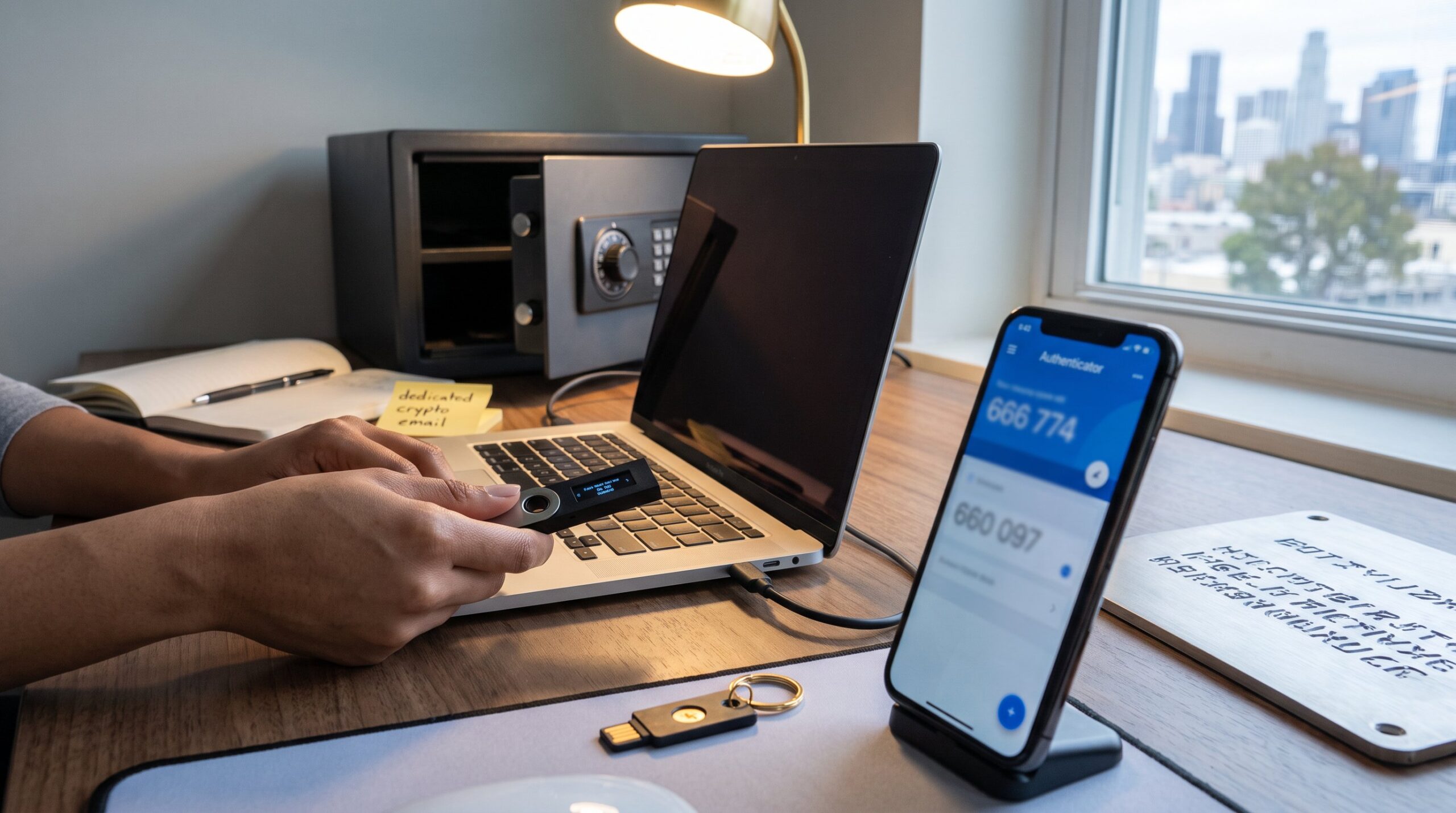
Enable two‑factor authentication (2FA) with an authenticator app or hardware security key: avoid SMS. Authenticator apps (like Authy or Google Authenticator) and FIDO2 hardware keys resist SIM‑swap and phone number takeover. For large accounts, register a hardware key for logins and withdrawal confirmations.
Email hygiene matters. Use a dedicated email address exclusively for crypto accounts and exchanges. This email should itself use a unique password and 2FA. Regularly review login alerts and active sessions, and sign out sessions tied to unfamiliar IPs or devices. If an exchange offers withdrawal whitelists, enable them.
A cautionary moment: one operator reported losing access after using the same email for personal and crypto accounts: an attacker gained access through a retail‑site breach and pivoted to exchange resets. Prevention: compartmentalize contact points and favor device‑bound authentication.
Choosing The Right Wallet: Custodial Vs Noncustodial And Secure Setup Steps
Choose custodial wallets for convenience and insurance features: choose noncustodial when control matters. Custodial services (exchanges, hosted wallets) hold private keys and often offer features like fiat on‑ramps and customer support. Noncustodial wallets put key control in the user’s hands, safer from exchange breaches but riskier if the user mismanages backups.
Secure setup steps: install wallet software only from official sources: verify developer names and checksums where provided: update firmware and software immediately: and create backups before transferring funds. During setup, write your seed phrase by hand on two separate media and store them in different secure locations. Never photograph, email, or cloud‑store a seed phrase.
For straightforward comparisons and compatibility notes, readers should understand wallet compatibility and device support: a practical reference on wallet compatibility clarifies which wallets support which chains and tokens.
Evidence note: industry guides show that custodial providers reduce some operational risks but concentrate counterparty risk: the right choice depends on the user’s threat model and the dollar amounts involved.
Best Practices For Hardware And Software Wallets
Keep the bulk of holdings in hardware (cold) wallets. Hardware wallets isolate private keys on a device that never exposes keys to the internet. Store hardware devices and recovery backups in a safe or bank deposit box. Update device firmware from the official vendor only, and verify firmware hashes when offered.
Use hot software wallets only for small, active balances. Limit daily operational funds to an amount the user is willing to lose. Run hot wallets on a dedicated, minimal‑use device with current OS patches and anti‑malware. Avoid public Wi‑Fi and use a trusted VPN when necessary.
Verify every transaction on‑device. When a wallet asks to sign a transaction, confirm the destination address and amount on the hardware screen, do not rely solely on the computer display. For added defense, use address‑whitelisting on exchanges and transfer targets.
For users deciding between wallet types and setup, industry primers like Investopedia’s wallet comparison provide a technical view on tradeoffs and are useful for first‑time buyers of hardware wallets: wallet choices guide. Practical example: one collector moved 95% of holdings to cold storage and kept 5% in a hot wallet for daily trades, reducing attack surface while preserving liquidity.
Ongoing Habits, Monitoring, And Recovery Planning
Regular monitoring prevents slow compromises. Review token approvals, connected dApps, and active sessions monthly: revoke unused approvals. Use block explorers to confirm on‑chain activity when alerts fire. Set small, realistic monitoring routines: 10 minutes each Sunday to scan logs and approvals.
Test recovery procedures. Perform a fire‑drill where the user restores a wallet from backup on an air‑gapped device to confirm seed phrases and backup integrity. Document a “break‑glass” recovery plan: who will restore access, what hardware is required, and where backups live. For sizable holdings, consider multisig or MPC setups that distribute signing power across trusted parties or devices. Multisig reduces single‑point failure risk: for instance, a 2‑of‑3 multisig requires two keys to move funds.
Store seed backups on durable materials, stainless steel plates survive fire and water. Keep at least two geographically separated backups. Never type or upload a seed phrase to a cloud service or password manager. Honest lesson: one user lost three months of trading gains after storing a screenshot of a seed phrase in cloud photos: attackers found it via a synced photo breach.
For coverage of broader crypto risks and market context, examine the site’s overview on crypto reserves, which explains institutional custody trends and reserve practices.
Conclusion
Protecting crypto requires layered defenses, tested backups, and disciplined habits. They should treat seed phrases like cash, use strong unique passwords, prefer app or hardware 2FA, and keep most funds in cold storage. Regularly review approvals, test recovery, and choose custodial options only after weighing tradeoffs. Small steps, compartmentalized email, a password manager, one hardware key, dramatically reduce risk and save real money.