

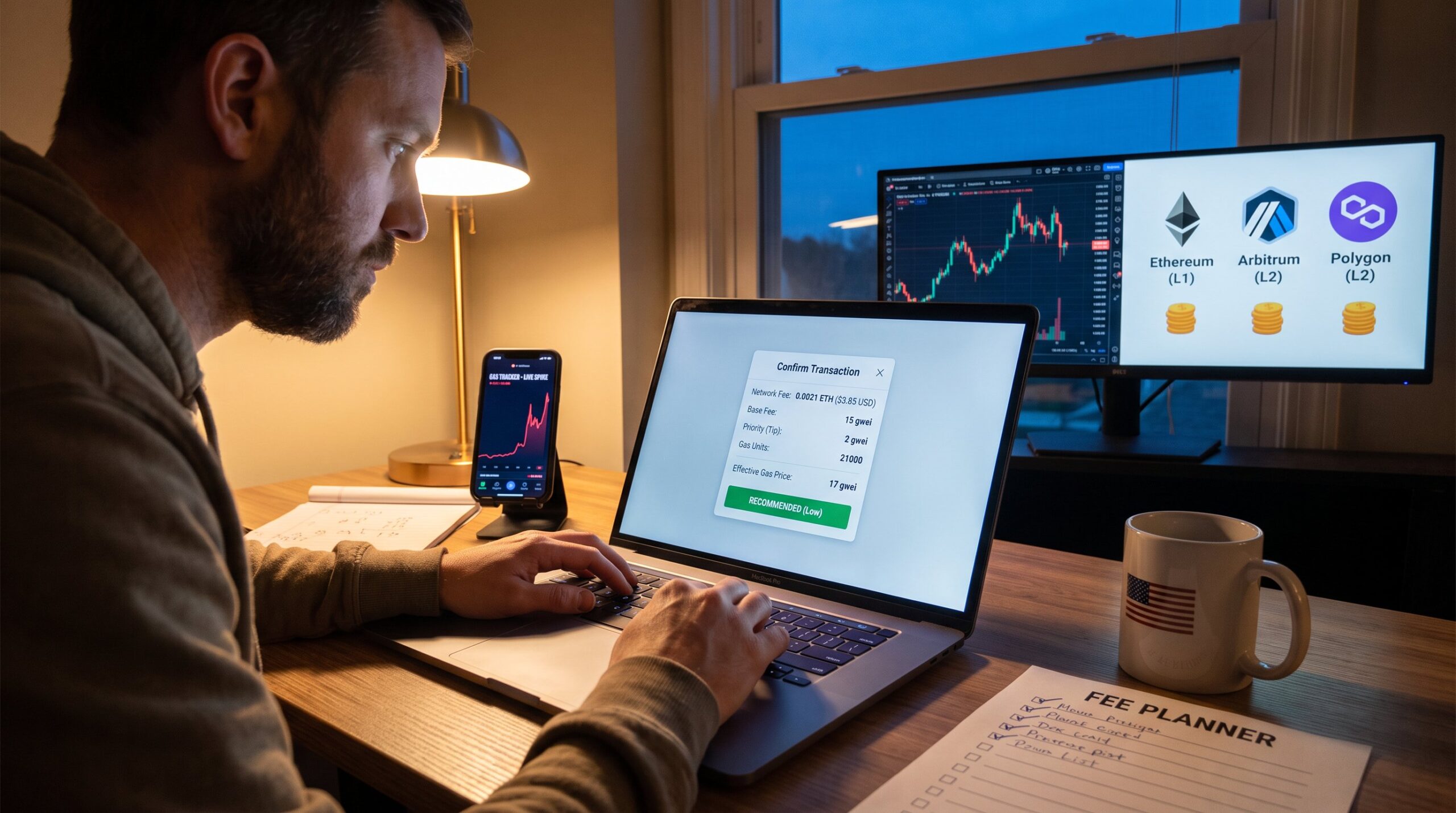
What Blockchain Fees Mean for Crypto Users is a practical look at mandatory transaction costs, how they form, and what they change for everyday holders and traders. Fees decide whether a transfer clears fast or stalls, they shift with demand, and they can turn a cheap swap into an expensive mistake. This guide explains components, why differences exist across chains, and concrete steps readers can use in 2026 to lower costs and plan timing.
Key Takeaways
- Blockchain fees are mandatory payments that affect transaction speed and cost, with base fees adjusting per network congestion and priority fees incentivizing validators to process transactions faster.
- Fees vary significantly between Layer 1 and Layer 2 blockchains, with L2 solutions dramatically lowering costs by batching transactions and offering cheaper micro-payments, making them ideal for frequent users.
- Different crypto actions consume varying amounts of gas: simple token transfers have low fees, while DeFi trades and NFT minting demand higher gas, increasing costs substantially.
- Using fee estimation tools and timing transactions during off-peak hours can reduce costs by 30–60%, while batching multiple operations and setting appropriate priority fees prevents overpaying.
- Bridging assets to Layer 2 can involve a one-time higher fee but pays off if conducting more than a dozen monthly transfers, often resulting in significant monthly savings.
- Planning monthly fee budgets, maintaining small reserves on each chain, and using wallets with gas tracking features help users optimize transaction costs and avoid costly mistakes.
How Blockchain Fees Work: Base Fees, Priority Fees And Gas
Fact: Blockchain fees are the required payment validators need to include and record a transaction. On Ethereum-style chains the cost breaks into measurable parts: base fee, priority fee (tip), and the gas units consumed.
The base fee sets a protocol-level floor per gas unit and normally burns that amount, shrinking supply. The priority fee is what a user offers extra to entice validators to pick the transaction quickly. Users also set a max fee per gas: the chain refunds any unused difference. For a single token transfer the network might consume 21,000 gas units: the total charge equals gas used × effective gas price.
Gas is literal accounting: complex contract calls use thousands to millions of gas: simple sends use far less. A concrete example: a simple ERC-20 transfer using 50,000 gas at a 20 gwei effective gas price costs 1,000,000 gwei, which equals 0.001 ETH at 1,000 gwei = 1 gwei = 10^-9 ETH (numbers simplified for clarity). That shows how small changes in gas price scale costs.
Practical warning: setting an excessively low priority fee can leave a transaction pending for hours. Conversely, blindly using the highest tip buys speed but erodes gains on small trades. Wallets now show base and recommended priority fees: users should review them before confirming.
Network Congestion And Fee Estimation Tools
Fact: Base fees rise when blocks approach capacity and fall when traffic eases. The protocol adjusts base fee per block using prior-block gas usage: this creates sharp fee spikes during congestion.
Gas trackers and fee estimators measure live base fee and typical priority fees. Tools like Etherscan gas tracker, block explorers for other chains, and wallet estimators show the current base and median tip. A practical routine: check a tracker 10–30 minutes before sending a high-value trade.
Example: during a major token launch in 2024, base fees jumped 3–5x within ten minutes. A trader who waited 90 minutes saved roughly $12 on a $100 swap: the difference beat slippage in that case. That shows how lightly timing matters.
Tip: use planner features that alert when base fees drop below a threshold. For recurring actions, salary payments, batch transfers, automating when fees are low can save real money each month.
Why Fees Vary Between Blockchains And Transactions
Fact: Fees differ because protocols allocate block space, consensus overhead, and scaling designs differently. Demand, block size, and fee models create visible gaps between chains.
An L1 like Ethereum sells limited block space directly to users: that creates higher base fees when demand surges. Other L1s use different approaches: some have larger block windows, others use proof-of-stake variants with different validator economics. Transaction complexity also changes gas: simple transfers cost the least: contract interactions require more computation and hence more gas.
Specific numbers: in routine months, an Ethereum L1 token transfer might cost a few dollars to tens of dollars: the same action on an L2 can cost cents or fractions of a dollar. This gap stems from batching: L2s bundle thousands of transactions and settle a single proof to the L1, lowering per-transaction settlement cost.
Practical note: when moving funds between chains, bridging fees and two-step approvals add costs and time. Users should add expected bridge settlement fees into calculations before acting.
Layer 1 Vs Layer 2, Token Standards And Fee Models
Fact: Layer 2 solutions reduce per-transaction fees by aggregating state updates and posting summaries to Layer 1.
L1s (for example, Ethereum) carry the primary security and finality, so they keep settlement costs higher. L2 rollups, optimistic or zero-knowledge (ZK), batch many user operations and spread the L1 cost across them, making everyday actions dramatically cheaper. Examples in 2026: Arbitrum, Base, and Polygon zkEVM usually offer sub-dollar transfers for standard token moves.
Token standards (ERC-20, ERC-721) use the same EVM gas schedule, but functions differ: minting an NFT or executing a marketplace sale invokes storage writes and external calls, increasing gas. Fee models also vary: some chains levy fixed fees per transaction, others use market-priced gas like EVM chains.
Practical tip: pick an L2 for frequent trading or micro-payments. For high-value settlement or when maximum security is required, L1 may still be preferable even though higher costs.
How Fees Impact Common Crypto Actions (Send, Trade, DeFi, NFTs)
Fact: Different actions consume different gas patterns and deliver different fee outcomes.
- Send: lowest gas. A simple wallet-to-wallet token transfer uses minimal computation and is cheapest.
- Trade / DeFi: swaps, liquidity provision, and borrowing trigger multiple contract calls and often cross-contract interactions: gas usage multiplies. A single swap on AMM can cost 2–5x a basic transfer.
- NFTs: minting or interacting with on-chain metadata writes consumes high gas: marketplace operations may add royalties and multiple transfers.
Real example: a user in 2025 executed an on-chain NFT mint and paid $78 in gas: minting later on an L2 cost $0.45. This contrast shows why creators choose L2 marketplaces for lower buyer friction.
Practical warning: when expected profit margins are small, say arbitrage or micro NFT flips, the fee can erase gains. Always compute fee + slippage before committing funds.
Strategies To Reduce Fees And Optimize Timing
Fact: Users reduce fees by moving activity to L2s, timing transactions, and batching actions.
Strategy list:
- Use Layer 2s for frequent transfers and swaps to get per-action costs in cents. For readers new to L2, the site provides a broader primer in its how cryptocurrency works overview.
- Monitor live gas trackers and transact during off-peak hours. A disciplined routine, doing non-urgent transfers at night, can cut average fees by 30–60% in some months.
- Batch and bundle: wallets that aggregate multiple sends or contract calls save on repeated base-fee components.
- Set conservative priority fees: pick a tip that fits current median rather than the top percentile to avoid overpaying.
Practical warning: bridging assets to an L2 can cost a one-time larger fee: calculate break-even: if a user plans >12 monthly transfers, moving to an L2 usually pays off. For a step-by-step framework and risk overview, consult the site’s broader crypto guide at crypto primer.
Example action plan: for regular DeFi activity, the user moved recurring swaps to an L2, saving about $110 per month across 24 trades, real savings that justified the bridge cost after two months.
Real-World Examples, Typical Fee Ranges And Planner Tips
Fact: Typical fee ranges vary by chain and action: think cents on efficient L2s, dollars to tens on L1s, and tens to hundreds for complex contract activity during congestion.
Concrete examples (typical, 2024–2026 period):
- L2 token transfer: $0.01–$0.50
- L1 token transfer: $1–$30 depending on congestion
- Complex DeFi swap on L1: $5–$80
- NFT mint on L1 during peak: $30–$200
Planner tips:
- Set a monthly fee budget. Track actual fees spent for a quarter: if average monthly fees exceed a target, shift more activity to L2s or batch tasks.
- Keep small reserve balances on each chain to avoid costly emergency bridges.
- Use wallets that show historical median fees and let users choose fee presets (slow, recommended, fast).
Evidence note: independent analysis of fee-heavy months shows spikes tied to major drops and token launches: users who delayed nonurgent actions saved meaningful sums. For a broader view of fees, taxes, and hidden costs, industry reporting like the Investopedia analysis helps verify total expense calculations (fee study).